
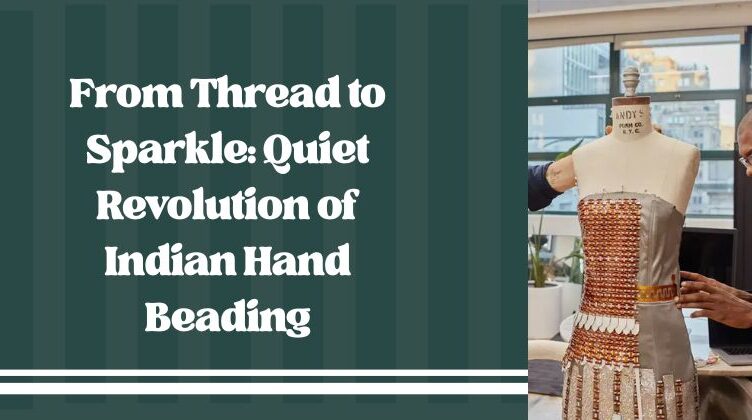
Indian Hand Beading revolution is woldwide popular. Walk into a high-end boutique in Milan or Paris, run your hand over a gown that costs more than a mid-sized car, and look closely. Past the label of cotton and silk. From the shadow-work of Chikankari mercury, or pearls stitched with mathematical precision, you aren’t just in the north to the narrative tapestries of Kantha in the east; our luxury was defined by, past the silk lining, right down to the surface. If you see thousands of microscopic glass beads, sequins that catch the light like liquid, you are looking at European design. You are looking at Indian thread. We were the storytellers and the dyed yarn. But in the last few decades, a shift has occurred—subtle, glittering, and profound. The definition of “Indian Hand-Beading Embroidery” has expanded, morphing hands.
For centuries, India was the land of the Hand emroidery designg, from the matte finish of thread work to the high-octane glamour of Indian hand beading.
This isn’t just a change in materials; it’s a transformation of an entire artisanal ecosystem.
The Zardozi Gateway:
To understand how thread turned into beads, you have to look at the bridge: Zardozi. In history, Zardozi was the gold sewing art. It used metallic wire (badla) to create raised, opulent designs for Mughal courts. It was heavy, regal, and entirely metallic.
But as the 20th century turned into the 21st, fashion became faster and lighter. The heavy gold wire was too cumbersome for modern silhouettes. Artisans, particularly in regions across Uttar Pradesh and West Bengal, began adapting. The same hooked needle used for Zardozi—the aari—was perfect for picking up beads and sparkled as Indian Hand-Beading.
The aari technique is distinct from the sewing needle used in the West. A beader in France might use a Luneville hook, but the Indian aari artisan works with a speed that blurs the vision. They hold the thread beneath the fabric frame (adda) and the hook above, feeding sequins (sitara) and glass beads (moti) onto the fabric in rapid, chain-stitch successions. This adaptation allowed Indian ateliers to produce beaded fabrics at a speed and intricacy the rest of the world couldn’t match to the Indian Hand-Beading technique.
Read This: Indian Hand Beading: Quiet Revolution from Thread to Sparkle
The Demand for “Bling”:
The shift wasn’t accidental; it was market-driven. The global perception of luxury shifted from “complex weave” to “visible shine.” In the West, couture houses like Chanel, Dior, and Valentino ramped up their demand for embellishment. Simultaneously, the Indian bridal market exploded.
The modern Indian bride didn’t just want the red silk of her grandmother; she wanted to sparkle under the reception lights. Thread work, no matter how exquisite, absorbs light. Beads and crystals reflect it. The economy of aesthetics dictated that embroidery had to evolve. A Resham (silk thread) motif is quite elegant; that same motif filled with Japanese Miyuki beads is a statement.
This demand forced traditional embroiderers to retrain. Men whose fathers spent their lives doing shadow work on white muslin found themselves learning to handle Swarovski crystals. The palette changed from organic dyes to metallic glass.
The Human Cost of Sparkle:
There is a tactile difference in the work, too. Thread embroidery is forgiving; it moves with the fabric. Beading is structural. It adds weight. An artisan working on a heavily beaded bodice isn’t just decorating cloth; they are engineering a garment. They have to account for the drag of the glass, ensuring the tulle doesn’t tear under the weight.
It is gruelling work. Beading requires a different kind of eyesight and patience. The thread can be unpicked and redone; a misplaced bead in a complex sequence can throw off the geometry of an entire pattern.
Yet, this transition has saved many craft clusters from extinction. While machine embroidery has largely killed the market for basic hand-stitched thread work (machines can mimic satin stitches perfectly now), machines cannot replicate the chaotic, three-dimensional complexity of hand beading. You cannot feed a mix of tubes, pearls, and sequins into a machine and get a randomized, organic scatter pattern. That requires a human eye and a human hand.
A Hybrid Future:
We are now seeing a fascinating synthesis. The line between “embroidery” and “beading” is dissolving. Contemporary designers like Rahul Mishra or Gaurav Gupta don’t choose one over the other; they merge them. You might see a French knot (traditionally, thread) made out of a cluster of seed beads. You might see the outline of a flower done in silk thread, but the petals are filled with cut-glass tubes.
This hybrid style is the new face of Indian craftsmanship. It preserves the grammar of traditional embroidery—the motifs of paisleys, vines, and lotuses—but translates them into the vocabulary of modern glamour.
Indian embroidery hasn’t disappeared; it has just put on a new coat of armor. It has traded the matte silence of cotton for the glass-clinking noise of beads. It is a survival strategy, a business model, and an art form all at once. The next time you see a dress that shimmers like a starry night, remember that the stars were placed there, one by one, by a hand holding an aari, continuing a legacy that refuses to fade.